What is a Digital Twin?
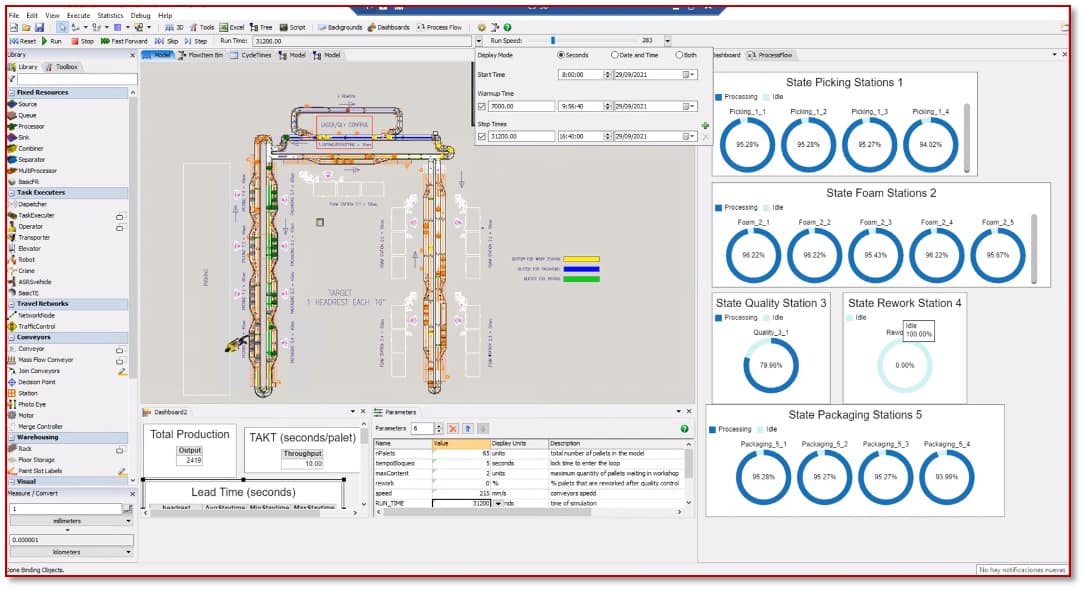
A digital twin is a virtual replica of a process, machine, production line, or logistics facility that accurately reproduces its operation in real time or through simulation.
Thanks to this technology, it is possible to visualize and analyze the behavior of a facility before construction, during commissioning, or while it is in operation, facilitating data-driven decision-making.
Digital twins allow you to:
- Simulate industrial and logistics processes.
- Validate designs before manufacturing.
- Identify bottlenecks and areas for improvement.
- Optimize resources and production capacity.
- Reduce implementation times.
- Improve planning and maintenance.
- Minimize risks and investment costs.
Digital Twins and Industrial Process Simulation
Before undertaking a project, questions may arise that we don't see until the equipment has been manufactured and tested, such as bottlenecks, process sequencing, and verifying cycle times.
Another option we offer our clients is process development through simulations. This allows us to assess whether the proposed transport system and accessories fit the initial plan or if changes are needed.
Another tool in high demand today is the integration of QR code readers into assembly lines for product and process sequencing.
We help companies optimize their processes by developing digital twins and advanced simulation tools. These technologies allow for the creation of a virtual representation of facilities, production lines, and logistics systems to analyze their performance, identify improvements, and reduce risks before making any investments or modifications to the actual plant.
Simulation of Production Lines
Before investing in automation or modifying an existing facility, it's crucial to understand how the changes will affect the overall system performance.
Using simulation tools, we can analyze:
- Material and work flows.
- Assembly line performance.
- Conveyor and sorting systems.
- Pallet and package movements.
- AGV and AMR operation.
- Pickping and shipping processes.
- Production and logistics capacity.
- Performance under different demand scenarios.
This allows for more confident and accurate decision-making.
Benefits for Industry
The use of digital twins offers significant advantages in all phases of the project:
Design and Validation
It allows for the verification of layouts, equipment, and processes before manufacturing and installation.
Operational Optimization
It helps identify inefficiencies, bottlenecks, and opportunities for improvement in production or logistics.
Cost Reduction
It minimizes design errors, subsequent modifications, and downtime.
Training and Commissioning
It facilitates the training of operators and technicians through secure virtual environments.
Predictive Maintenance
It allows for the analysis of equipment behavior and the planning of actions before incidents occur.

